What is Vercel, how it works, and what it's used for in 2026: complete guide
Vercel is the favorite deploy platform for Next.js. We explain how it works, what makes it different from Netlify or Railway, and why everyone from startups to large enterprises uses it.

Miguel Fernandez
Autor

What is Vercel, how it works, and what it's used for in 2026: complete guide
If you're evaluating platforms to deploy your next web application, Vercel is almost certainly already on your shortlist. And for good reason: over the last few years it has become the de facto standard for teams working with Next.js, React, and modern JavaScript frameworks.
But hype alone is never enough to make a serious technical decision. Is Vercel really worth the cost? Is it the right option for your business, or are there more convenient alternatives depending on your use case?
In this guide we'll explain exactly what Vercel is, how it works under the hood, and most importantly, when it makes sense to use it and when it doesn't.
What is Vercel?
Vercel is a deployment and hosting platform specialized in the modern frontend. It was founded in 2015 by Guillermo Rauch, the same creator of Next.js, which explains the seamless integration between the two tools.
Its core promise is simple: you connect your GitHub, GitLab, or Bitbucket repository, and Vercel takes care of compiling, optimizing, and deploying your application automatically every time you git push. No servers to configure. No complicated pipelines. No headaches.
How Vercel works under the hood
Global CDN network
When you deploy to Vercel, your application does not live on a single server. Static content — HTML, CSS, images — is distributed across a global CDN network with more than 100 points of presence around the world.
This means a user in Mexico City, Madrid, or Tokyo sees your site from the node closest to them. The practical result is very fast load times, which directly impacts your Google ranking and your business's conversion rate.
Serverless Functions and Edge Functions
Vercel does not only serve static content. It can also run server-side logic through two mechanisms:
- Serverless Functions: functions that run on demand on AWS infrastructure. Ideal for APIs, authentication, and database queries.
- Edge Functions: code that runs directly on CDN nodes, milliseconds away from the user. Perfect for content personalization, dynamic redirects, and security middleware.
Preview Deployments
Every pull request automatically generates a unique preview URL. This allows your design, product, or QA team to review changes before they reach production, eliminating one of the most common bottlenecks in agile development cycles.
Vercel and Next.js: the most natural combination on the market
If your stack includes Next.js, Vercel is the most natural option available. That is no coincidence: Vercel builds and maintains the framework, so it guarantees first-class support for every new feature.
That includes the App Router, React Server Components, Incremental Static Regeneration (ISR), automatic Image Optimization, and Streaming SSR with no additional configuration.
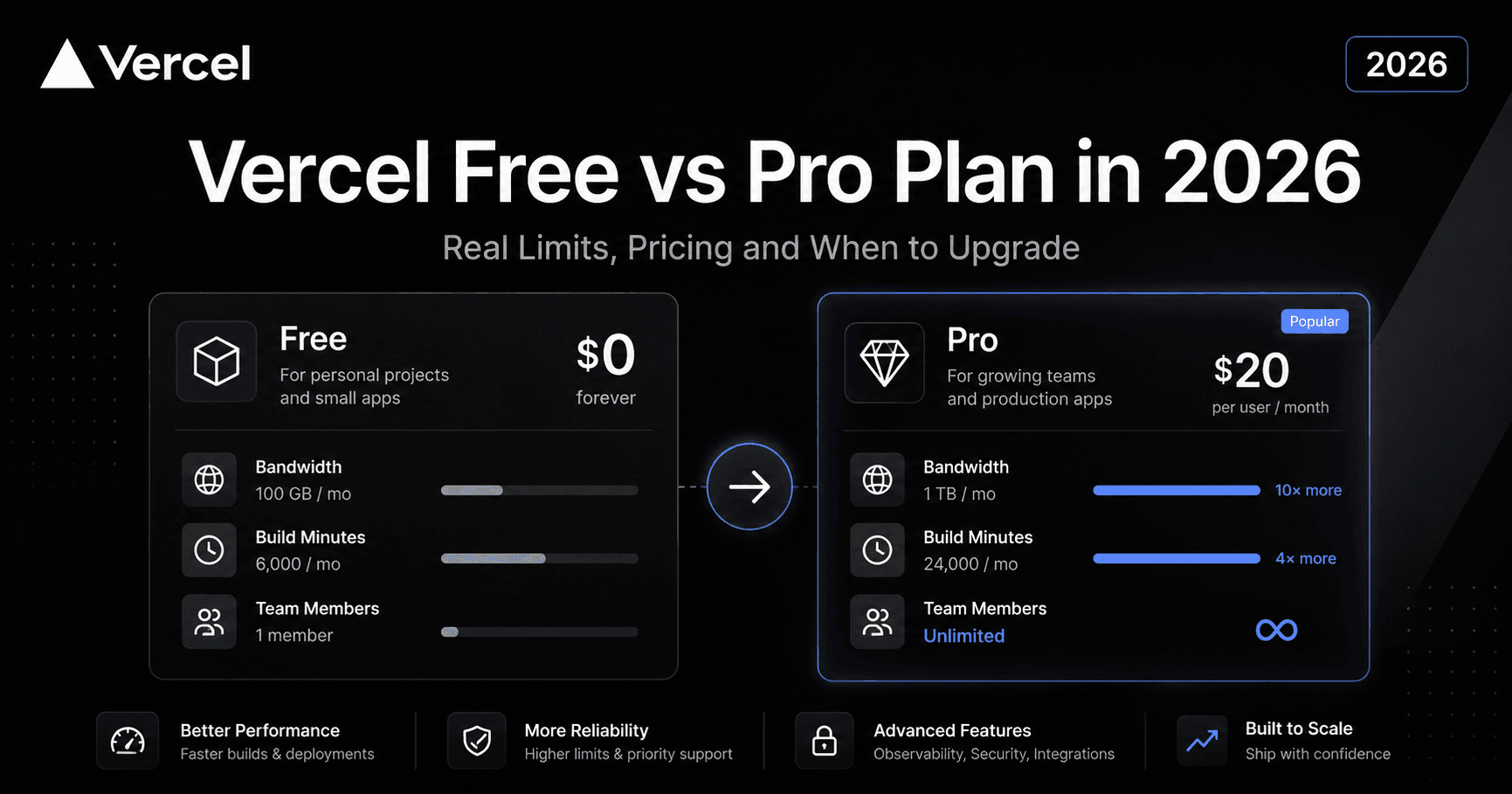
Deploying a Next.js app on Vercel boils down to: import repository → deploy. If you're evaluating what hosting budget makes sense for your team, you can read our practical comparison of Vercel Free vs Pro Plan in 2026.
Vercel pricing in 2026
Vercel has three main tiers:
| Plan | Price | Who it's for |
|---|---|---|
| Hobby | Free | Personal projects, portfolios, experimentation |
| Pro | $20 USD/month per member | Startups and teams with projects in production |
| Enterprise | Custom pricing | Companies with advanced security, SLA, and support requirements |
The free plan is generous for personal projects, but it does not allow commercial use and has limits on bandwidth and serverless function execution.
Important: if you have significant traffic or multiple production projects, the cost scales quickly. It is worth evaluating alternatives before committing.
When NOT to choose Vercel
Vercel is excellent for many cases, but there are scenarios where other platforms make more sense.
When you need full control of the infrastructure
If your company requires that data never leaves a specific region, you need strict compliance (HIPAA, your own SOC 2), or you prefer not to depend on a third party, a self-hosted solution like Coolify may be a better fit. We documented this experience in our case study on how we built our own infrastructure with Coolify.
When cost is the top priority
For early-stage startups on a tight budget, platforms like Railway offer an interesting balance between simplicity and cost. If that comparison interests you, we covered it in detail: Coolify vs Railway: which should you choose for your startup?
When your backend is not JavaScript
Vercel is optimized for the JavaScript/TypeScript ecosystem. If your backend application is in Python, Go, Ruby, or PHP, other platforms offer better support and less friction.
When your processes run longer than 60 seconds
Vercel Serverless Functions have an execution time limit of up to 60 seconds on the Pro plan. If you need to render PDFs, process images in bulk, or run background jobs, you need a different architecture.
Real-world use cases
E-commerce agency in Monterrey. An online store with a catalog of more than 5,000 products migrated to Vercel with a Next.js frontend connected to Shopify as the backend. Load times dropped from 4.2 seconds to less than 1.5 seconds, resulting in an 18% increase in conversion rate within the first three months.
B2B HR SaaS. A Mexican startup offering payroll management software built its client dashboard in React and deployed it on Vercel, connecting it to its Node.js API hosted separately. Preview deployments allowed them to cut their review cycle from 5 days to 1 day by eliminating the need for manual staging environments.
Content portal for digital media. An editorial group with presence in Mexico and Colombia deployed its site with Next.js and ISR on Vercel. Content updates automatically without requiring a full rebuild, and the global CDN guarantees similar response times for users in both countries.
Vercel and artificial intelligence
In 2025 and 2026, Vercel bet heavily on AI integration. Its Vercel AI SDK became one of the most popular tools for building applications with LLMs like GPT-4, Claude, or Gemini, with native support for streaming, tool calling, and agent orchestration.
If you plan to add AI to your next web application, the Vercel AI SDK is a solid starting point. And if you want to integrate external tools into your applications, you can also explore how to create your first MCP server with TypeScript.
How to get started on Vercel today
The process of deploying your first application takes less than 10 minutes:
- Create an account at vercel.com — the Hobby plan is free.
- Import your repository from GitHub, GitLab, or Bitbucket.
- Configure the environment variables your project needs.
- Click Deploy — Vercel detects the framework automatically and configures the build.
For Next.js, the process is especially smooth thanks to automatic detection and the default configuration.
Evaluating whether Vercel is the right platform for your project or company? At fencode we help you make that decision on solid technical ground with no conflict of interest. Contact us here and tell us what you're working on.
Tags:
Preguntas Frecuentes del Artículo
Resolvemos las dudas específicas sobre este tema.